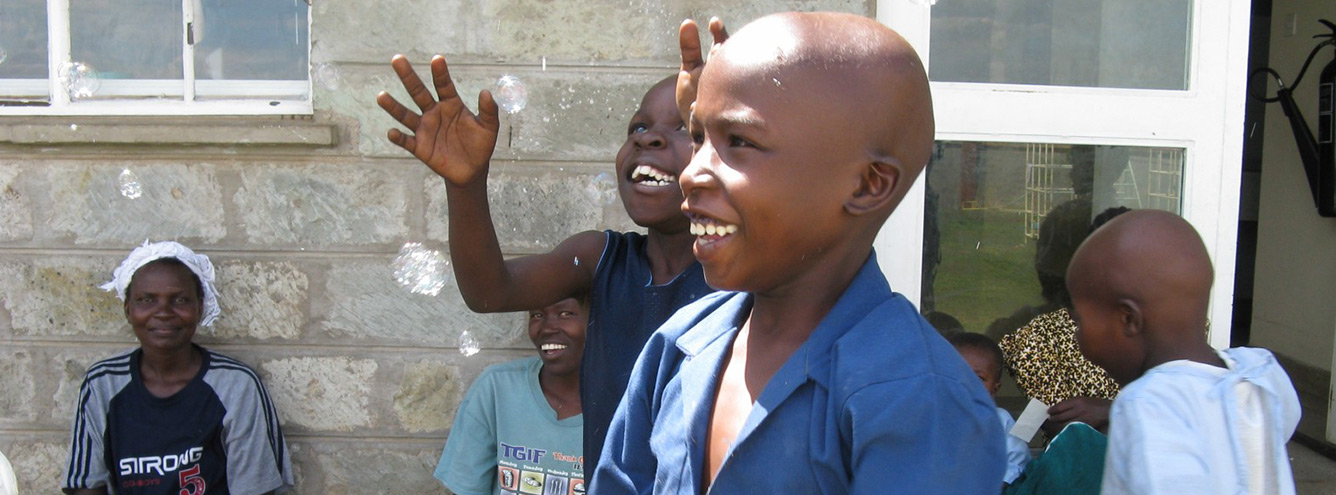
Fewer than three in ten children survive eye cancer five years beyond diagnosis in Africa – but Kenya proves the future is full of hope.
Many precious children can be saved by increasing early diagnosis, improving access to existing treatments, strengthening medical care, and supporting families throughout the cancer journey. The Kenya National Retinoblastoma Strategy (KNRbS) is achieving this transformation.
Established in 2008, the KNRbS is a collaboration of medical professionals, families, advocates, and government leaders, building effective, sustainable care for children with retinoblastoma, survivors, and families across Kenya – and offering a model for other countries to follow.
Why Kenya?
Kenya was an ideal starting point for WE C Hope (then Daisy’s Eye Cancer Fund) to develop a model retinoblastoma strategy for Low- and Middle-Income Countries (LMICs):
- A relatively stable economy, political landscape, and health system.
- Nairobi as a key transport, financial, training, and aid hub for Eastern Africa.
- 25% of sub-Saharan Africa’s eye care workers are trained in Nairobi.
- Children travel from across the region to Kenya for retinoblastoma care.
- A deeply personal connection – John White, father of WE C Hope’s co-founder Abby, was born in Kitale, western Kenya, and diagnosed with bilateral retinoblastoma in 1946.
A Diverse, Committed Team
The KNRbS group brought together more than 50 people from across Kenya, including:
- Ophthalmologists.
- Ophthalmic clinical officers.
- Oncologists.
- Nurses.
- Pathologists.
- Pharmacists.
- Social workers.
- Child life leaders.
- Scientists.
- Parents and survivors.
- Health advocates.
- Community and government leaders.
Together, they worked to close critical gaps in care and build a national standard for retinoblastoma treatment and family support.
Collaborative Power at the Annual Meeting
A key goal from the outset was to develop evidence-based clinical care guidelines, tailored to Kenya’s needs and resources.
This is a slow process, requiring thorough literature searches and open discussion among a wide range of professionals until published evidence is identified or consensus is reached to support each recommendation. The resulting guidelines provide a national standard for care, giving children the best possible chance of cure, quality of life, and lifelong care.
WE C Hope facilitated the annual 3-day KNRbS meetings, together with Brenda Gallie M.D., retinoblastoma ocular oncologist; and Dr. Helen Dimaras, Global Eye Health scientist – both from Toronto’s Hospital for Sick Children. These meetings became a central feature of the national strategy, supporting:
- Collaborative problem-solving and innovation.
- Review of progress and goal setting.
- Professional development and training.
- Knowledge-sharing and vital peer support.
These retreats enabled honest, thorough conversation, and agreement about complex topics. For example, the use of orbital exenteration for children with retinoblastoma extending into the eye socket. After much debate, the group agreed this traumatic surgery was not effective and should be avoided wherever possible.
Timeline of Progress
2008: Mapped existing clinical and support services, identified challenges, priorities, and possible solutions to access barriers and gaps in care.
2009: Began drafting national guidelines with task groups focused on awareness and education, screening, features and classification of Rb centres, referral and diagnosis, genetics, treatment, follow up, and psychosocial support.
2010–2012: Continued developing the guidelines through collaborative meetings.
2013-2014: Integrated guidelines into medical practice across the country.
2015: Kenyan Guidelines for Retinoblastoma Care were officially adopted by the Ministry of Health, and folded into the National Cancer Strategy. Kenya became only the second country to implement national guidelines for Rb care, along with Canada.
The guidelines are reviewed regularly to ensure they remain relevant and promote best practice. The 2019 updated Kenyan Rb Care Guidelines are available via ACE-at NCD (African Research Universities Alliance Centre of Excellence for Non-Communicable Diseases).
Capacity Building in Action
Annual KNRbS meetings also empowered participants to share knowledge and experience, build practical skills, and deepen empathy across disciplines. The mix of presentations, whole-group discussions, workshops, and small group activities helped them to understand different parts of medical care from varied perspectives.
For example:
Genetics Session
During a genetic counselling workshop, participants role-played consultations in which medical professionals, parents, and survivors discussed real-life scenarios and their implications. This prompted valuable discussion about the family’s potential experience, and the role of genetic counselling in patient care.
Knowledge increased and participants reported feeling more confident about discussing genetic counselling with patient families. Follow up research found that frequent refresher training supports knowledge retention and confident discussions for optimal patient care.
Child Life Session
During a child life practices workshop, small groups created storybooks and scripts for different medical procedures, explaining each step of the process in simple terms for both parent and child.
Participants found this helped them re-evaluate their experience of routine procedures from the perspective of a frightened child and overwhelmed parent, and consider simple ways to ease family distress. The practical session highlighted the value of working with child life specialists in the clinical setting to enhance patient care.
At every meeting, the KNRbS task forces (awareness, medical care, family support, and resource mobilisation) evaluated their achievements and challenges through the previous year, then set new goals and tasks for the next twelve months. Each task force presented their outcomes and work-plan to the entire delegation for further discussion. A great deal of positive progress was made with this collaborative approach.
Milestones in Care and Impact
Working with local and international partners, WE C Hope and the KNRbS:
- Developed early signs awareness information, included in the Mother and Child Health Booklet (see p. 25). The booklet is used by parents and healthcare workers nationwide. KEPI Nurses (Kenya Expanded Program for Immunization) were also trained to use this new content, and refer promptly if concerned.
- Introduced a referral protocol to speed up diagnosis and care.
- Delivered the first Retcam to sub-Saharan Africa in 2009, in partnership with ORBIS and the manufacturer, Clarity Medical Systems. The Retcam allows high resolution imaging of a child’s eyes, enhancing, diagnosis, telemedicine, training, parent understanding, and decision-making.
- Established the Retinoblastoma Collaborative Laboratory (RbCoLab) in Nairobi, for faster collaborative pathology review across treatment centres. Pathology slides can be scanned and viewed on a computer in ultrahigh resolution, supporting personalised patient care, telemedicine, and training. Improved pathology and communication reduced turnaround time from more than 6 months to less than 2 weeks, guiding optimal post-operative care.
- Created a family support program to help caregivers stay with their child and cover essential costs – now continued by local charities.
- Established Africa’s first child life training program, now supporting child-centred care in Kenya, Ghana, South Africa, and Malawi.
National Leadership and Endorsement
The KNRbS gained support from prominent national leaders:
- Prof. Anyang’ Nyong’o, Minister for Medical Services (2008–2013), praised the ground-breaking partnership of public, private, and mission hospitals, government, and patient advocates to improve early diagnosis and care.
- Dr. Michael Gichangi, Director of Ophthalmic Services in the Kenya Ministry of Health, and active in the KNRbS from its inception, celebrated the holistic, community-driven model to advance eye cancer care and cure.
- Mr. Samson Ndegwa, Chair of Lions Loresho Eye Hospital, affirmed the child- and family-focused approach as central to success.
A Model for Africa and Beyond
Since the National Rb Strategy launched, coordinated care has helped raise retinoblastoma survival in Kenya from 26% in 2008 to 70% today. Inspired by this progress:
- Ghana is now developing a national strategy.
- Other countries are exploring coordinated approaches to awareness, diagnosis, treatment, and support.
Kenya’s experience offers a compelling blueprint for any country seeking to improve diagnosis, care, and outcomes for children with retinoblastoma. With collaboration, creativity, and commitment, transformation and life-saving care for all is possible.