

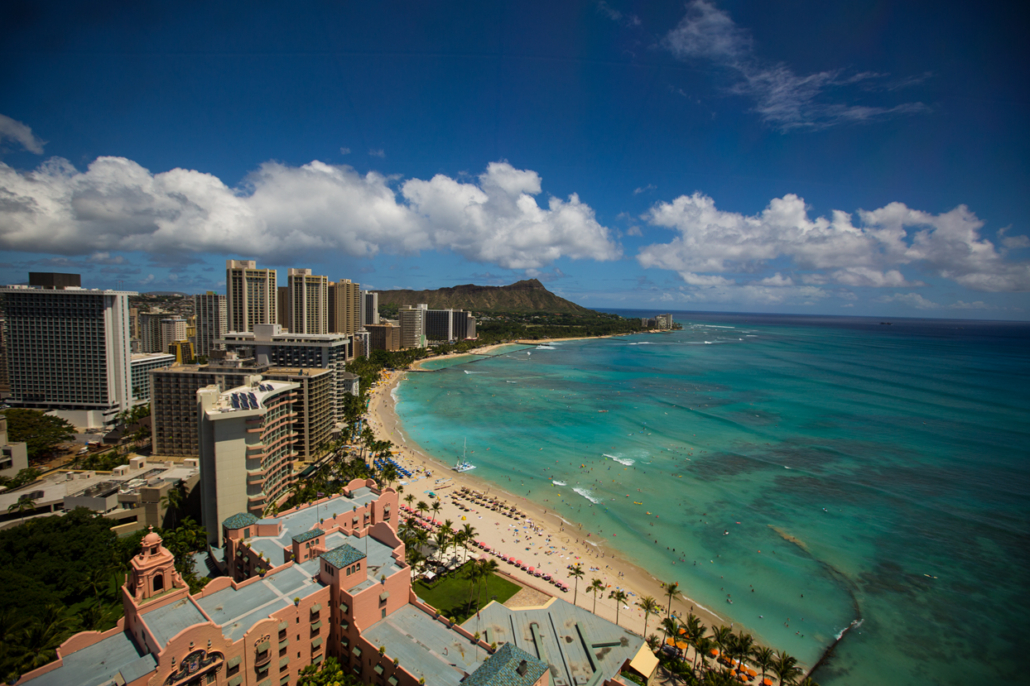
Waikiki Beach and Leahi (Diamond Head). | Credit: Hawaii Tourism Authority /Dana Edmunds
One Retinoblastoma World 2024 will take place in Honolulu, Hawaii.
Hawaii is the most southerly state within the United States of America, and also the world’s most remote archipelago (chain of islands). It is located on the Tropic of Cancer in the mid-Pacific Ocean, 2,400 miles from the continental USA (the nearest landmass).
The Hawaiian Islands comprise 8 main islands – Hawaiʻi, Maui, Oʻahu, Kauaʻi, Molokaʻi, Lānaʻi, Niʻihau, Kahoʻolawe. A chain of more than 150 uninhabited islets, atolls, seamounts, and shoals extending 1,350 miles northwest from the main island group form the Papahanaumokuakea Marine National Monument, a vast World Heritage Site and protected conservation area.
Oʻahu is the third largest Hawaiian island, and home to just over 1 million people (roughly 70% of Hawaii’s population). Also called “The Gathering Place”, Oʻahu is a fusion of East and West rooted in the values and traditions of the Native Hawaiian people. A treasure island waiting to be explored, from diverse culture woven into bustling modern city life, to stunning natural landscapes, laidback coastal communities, and ancient customs honouring land, sea and sky.
Honolulu is Hawaii’s cosmopolitan capital city, located on Oʻahu’s south shore. It has everything you’d expect in a busy metropolis – from historic landmarks to fine dining, green open spaces to world-class shopping. Metro Honolulu stretches across the southeastern shore, from Pearl Harbor to Makapuʻu Point. Towards the leeward coast (west), it encompasses Waikīki, where our conference hotel is located.
Here are some practical points for planning your visit to Oʻahu and Honolulu / Waikiki for One Rb World.
COVID-19 Entry Requirements
Hawaii removed all COVID-19 related entry requirements for domestic travel on 26 March, 2022. US residents no longer need proof of vaccination or testing results to visit any of the islands. Restrictions may still apply for visitors from some international countries, and all are subject to change.
When planning your trip, do check the latest entry requirements for your country before setting out. Especially as the state has a history of tight restrictions and strict enforcement. We recommend choosing a travel insurance with clear and comprehensive COVID-19 cover.
Travel Documentation Requirements
As a member state of the United States, Hawaii observes federal entry requirements for domestic and international travellers.
If you need a visa or visa-waiver to travel to the USA, you will need the same for travel into Hawaii. There are no additional requirements. If you visit a different US state or territory on route to Hawaii, and pass through immigration there, you will be welcomed as a domestic traveller on arrival in Hawaii. Domestic travellers must present an acceptable ID, such as a valid passport, state-issued enhanced driver’s license, or U.S. military ID.
Visa Enquiries
When potential delegates contact us with concerns about visa approval, registration will be reserved at the level valid at that time. Please contact Marissa Gonzalez (marissa(at)wechope.org) if you require an invitation letter.
Time Zone
GMT/UTC -10. Hawaii does not observe summer time change as there is little variation in sunrise/sunset timing throughout the year within the Tropics.
October Weather
With near perfect weather, October is a great time to visit. Temperatures hover in the balmy mid to high 80s, with a balancing sea breeze. Pleasant evenings drop into the 70s; you’ll barely need a jacket. October also offers the warmest ocean temperatures – ideal for swimming, water sports and barefoot moonlit strolls along the shore.
As the rainy season begins in November, there’s a very small chance of early rain, but nothing to ruin your day. Our conference hotel is located on the leeward – south shore of Oʻahu, which typically experiences less rain, and any rain will most likely fall at night, refreshing the sultry air. Rare daytime rain will be a sudden, brief downpour that dries up fast in the tropical heat.
Temperatures can vary widely from coast to mountain. Higher altitudes mean lower temperatures, even in tropical Hawaii. If you plan to venture up into the wilderness, bring warm hiking clothes and sturdy shoes so you aren’t miserably cold while exploring the islands’ natural splendour.
The only potential downside to October’s weather: this is hurricane season in the central Pacific. However, tropical cyclones rarely hit Hawaii. SIOP selects its venues very carefully, considering many factors, including the likelihood of severe weather events disrupting the meeting, safety, and travel for thousands of oncology professionals. Just be aware it’s a small possibility.
Travelling with Kids?
When you book your hotel stay, check about reserving equipment like crib, playpen and rollaway bed. Also check out Paradise Baby Co., a full-service baby equipment rental company that stocks everything you’d likely need for your little ones during your stay, from cribs, strollers, wagons and car seats to changing mats, potty chairs, bottles warmers and sterilizers, high chairs, playpens, toys, and safety gates. They will deliver directly to the hotel in time for your arrival, and arrange collection when you’re ready to leave.
Travelling with a Guide Dog?
Daniel K. Inouye International Airport in Honolulu is the only port of entry for service dogs entering Hawaii, unless a valid Neighbor Island Inspection Permit has been issued by the Hawaii Department of Agriculture.
Hawaii is rabies-free and has strict entry requirements for service dogs. These apply to US residents as well as international visitors – please review the State of Hawaii guidance for Guide Dog Handers and plan your dog’s vet care early.
Getting to Honolulu
Honolulu is served by Daniel K. Inouye International Airport (HNL), offering multiple US and international flights daily. Frequent flights throughout the day also operate between neighbouring islands. Hawaii Airlines offers these Honolulu airport tricks and tips.
Our conference hotel offers an airport shuttle service with FareHarbor. Fees apply, and reservations are required. Booking well in advance is strongly recommended. Book your airport transfer with FareHarbor.
Climate-Friendly Travel
Conflicted about flying long-haul to reap the many big benefits of being in-person at this unique and infrequent One Rb World event? The following practical tips may be helpful as you plan your trip.
Choose Low-Carbon Airlines
Choose airlines that have more environmentally conscious practices and use more fuel-efficient aircraft. Here are three easy ways to identify these airlines:
- Look for IATA’s Environmental Assessment (IEnvA) Program This is an independent environmental management and evaluation system for the airline industry. Certification shows the airline is committed to higher environmental standards. Programs like Airport Carbon Accreditation also indicate an airline’s commitment to managing and reducing its carbon footprint.
- Independent environmental rating programs like Skytrax and Atmosfair provide rankings for airlines based on their environmental performance.
- Check if the airline offers a carbon offset program and whether that program is transparent and certified by credible organizations. This may not be obvious during the booking process – you may need to look for a specific sustainability (or similarly labelled) tab for information and options. Airlines that directly invest in sustainable projects and environmentally responsible practices are preferable to those that only offer customers the option to pay extra for carbon offsetting.
Offset the Carbon Cost of Your Travel
Carbon offsetting programs encourage businesses and individuals to invest in environmental projects to compensate for the carbon emissions their activities cause. They are based on the principle that, since climate change is a global issue, reducing emissions anywhere has the same positive impact on the environment.
With a quick google search, you can find diverse opportunities offered by partners in your country. They typically support projects like renewable energy, reforestation, habitat conservation, and sustainable development in communities most affected by climate change.
The United Nations offers a carbon offsetting program that anyone can participate in, supporting varied projects throughout the developing world.
Getting Around
Renting a Car and Driving
Deciding to rent a car – or not – depends on what you plan to do and which islands you plan to visit in addition to Oʻahu. Most car rental companies operate at the airports for convenient pick up and drop off. The full range of vehicle options are available, and navigating island roads is easy with GPS and free maps provided by rental companies.
Hawaiian citizens ask that visitors help to preserve the harmonious way of life on the islands, and protect its fragile ecology. Consider your need to hire a car for this trip in the Hawaiian spirit of kuleana (responsible travel), and Mālama Honua (taking care of the earth). Some things to consider:
- Honolulu and surrounding areas are heavily congested, particularly during rush hour (6-9am, 11.30am-1pm and 3-6 pm). The driving population has ballooned since the 1960s on not designed to cope with this volume of traffic. In addition, many tourists drive slower while finding their way, viewing the environment, and are easily distracted.
- Parking is limited and can be expensive. Research the options at your hotel and locations you plan to visit – find out the cost, restrictions, and whether advance reservations is needed.
- On Oʻahu, restaurants, shops, beaches, activities, and key attractions like the Honolulu Zoo, Waikiki Aquarium, Kapiolani Park, and US Army Museum, are within walking distance of our conference hotel in Waikiki. If you’re not planning to go further afield, you won’t need a car.
- For sightseeing beyond Honolulu, a car lets you explore at your own pace. Oʻahu is a small island – without traffic, you can drive around it in two hours. But attractions outside the city can be spread out.
Consider the driving alternatives to car hire, which include:
- Taking an organized tour.
- Hiring a taxi. They are abundant in Honolulu and Waikiki, but can become costly when driving outside the metro area. Agree your general itinerary and hourly or daily fee in advance.
- Hiring Uber or Lyft, or a Show-Around guide with their own car. Again, negotiate your general itinerary and hourly or full-day fee in advance.
- Chartering a private shuttle. Joining together with others who are staying longer can save everyone money. For example, a group of 10 or more people will qualify for a Group Discount on the Go Oʻahu Card.
Hiring a car and driver can work our cheaper and more enjoyable than renting a car. Everyone in the party can relax and enjoy the experience, and benefit from the driver’s local knowledge – often discovering hidden gems that may otherwise have been totally missed.
If you do self-drive, “drive with Aloha”:
- Follow all road laws and safety advisories. Be aware that speed limits are generally lower than in the continental USA, and strictly enforced.
- Slow down for pedestrians, even if you don’t see a visible crosswalk.
- Try to learn the names of roads on your routes before your travel, so you can be confident asking for directions if needed.
- Pull over to admire the view safely. Don’t become distracted on the road, or hold up other drivers by slowing down.
- Don’t tailgate, or use your horn to indicate annoyance. This is considered extremely rude in Hawaii, where the horn is used only for emergent warning, or as a (happy honk) friendly greeting.
- Do use your signal, and do wave a “thank you” when other drivers show you courtesy such as letting you merge into their lane.
- Be aware that compass points aren’t commonly used for directions. Strongly connected to land and sea for centuries, you will hear locals say “mauka” (toward the mountains), “makai” (toward the ocean), “ewa” (west), “Diamond Head” (east), “windward” (direction the wind is blowing from), or “leeward” (direction the wind is blowing to). Hawaii’s dominant trade winds blow northeast to southwest. Windward describes the wetter north and east sides of the islands facing into the wind. Leeward describes the sheltered, drier south and west sides.
- Go slow on wet roads. Rain and sea spray reduce visibility and create a slick road as water cools the asphalt and heat rises from its surface. Driving slower reduces the risk that a car’s tires will lose their grip on the road surface, and skid on the film of water. Going slow helps maintain your ability to steer, and brake safely when needed.
Oʻahu’s TheBus Service
Oʻahu is the only island with a comprehensive public transport system, simply known as TheBus. Many top visitor attractions are on bus routes, including Chinatown, Iolani Palace, Sea Life Park, and the Polynesian Cultural Center. Weekday morning and afternoon rush hours can be busy, with less chance of a free seat. Rush hour in Oʻahu runs 6am to 9am and 3pm to 6pm.
TheBus Service Key Facts:
- Exact change is required for fare.
- 50% discount is available for children aged 6 to 17, passengers with disabilities, and seniors 65+ with a valid U.S. Medicare card.
- One child aged under 6 years rides free per fare-paying passenger, when not occupying their own seat.
- You can buy one-day, seven-day and monthly HOLO card passes, which allow unlimited rides during the time purchased.
- Bus drivers issue one-day passes.
- Monthly passes can be purchased at grocery stores including Fodland, Times Supermarket, and 7-Eleven stores.
- Call (808) 848-5555 for specific up-to-date route information.
The Waikiki Trolley
The Waikiki Trolley is a fun way to travel, offering a convenient hop-on, hop-off service throughout the day. Single and double-decker buses carry passengers on four themed routes in Waikiki, downtown Honolulu, and along the East Oʻahu coastline. Popular stops include Bishop Museum, Ala Moana Center, Honolulu Museum of Art, Foster Botanical Gardens, and Diamond Head Crater. Single line (valid for one day) and one-, four- and seven-day all-line passes are available.
- Red Line: cultural Honolulu tour.
- Blue Line: panoramic coastline tour.
- Pink Line: Ala Moana shopping shuttle.
- Green Line: scenic Diamond Head.
Cycling
Consider renting a bike instead of a car. Bike rentals are readily available, as are the sportier moped rentals. Biki, Honolulu’s bikeshare program offers more than 130 self-service stops. You can pick up a bike at one location and return it at another. Go for a single ride, buy a monthly plan good for unlimited 30-minute rides, or opt for 300 pre-paid minutes of bike time to use for rides of any duration over a period of days, weeks or months.
Hawaiian Style Moped and Bike Rentals are included on Go Oʻahu Card.
Be sure that everyone in your party is committed to longer rides before setting out – destinations further afield may be miles apart.
Walking
Honolulu, Waikiki, and other urban centres are very pedestrian-friendly. You’ll discover a treasure trove of bars, restaurants, attractions, entertainment, and tours to join simply by exploring on foot.
TheBus service connects locations across Oʻahu, opening up this island to a wealth of cultural and wilderness walking opportunities. Discover some of Hawaii’s unique beauty among quiet surf towns, rural farming communities, and spectacular scenery. Stroll, ramble and hike along relaxing coast-ways, tropical forest trails, and refreshing mountain paths; their inspiring views found nowhere else on earth.
Travel “Kuleana” in Hawaii
The Hawaiian culture of “kuleana” means taking responsibility for ones actions. During your stay in Hawaii, please help to protect and preserve the local environment. For example, bringing reef-safe sunscreen, avoiding plastic waste, observing wildlife preservation laws, and supporting local Hawaiian businesses.
We support responsible travel and put together 10 top tips for being kuleana during your visit to One Rb World 2024 in Hawaii.
Hawaiian Language
Olelo HawaiʻI is one of two official state languages in Hawaii, alongside English. Primarily spoken throughout history, the language was documented by missionaries during the 19th century. Once the primary form of communication throughout Hawaii, but brutally crushed by modernisation, UNESCO now considers Olelo HawaiʻI to be a critically endangered language.
Hawaiian Pidgin is much more widely spoken across the islands. This is a creole mix of Olelo HawaiʻI and English, with many corrupted and blended words from both languages.
In the last 20 years, the state has made great strides towards recovering Olelo HawaiʻI, opening Hawaiian language schools, and proudly integrating the language into daily life. For example, many street, names, venues, and events throughout the Islands use the Hawaiian language. You will see and hear the language all around you; if you can learn and use some Hawaiian yourself, you will be very much appreciated.
Olelo HawaiʻI has just 12 letters: the 5 vowels and 7 consonants (h, k, l, m, n, p and w). Plus an ʻokina symbol, represented in written form as the grave accent (`), or a left single quotation mark (‘). Meaning “separation”, it is a glottal stop – a hard break between two vowels, and is considered a consonant.
Go Hawaii has a simple pronunciation guide with some commonly used words and phrases, including audio clips of their pronunciation.
The Hawaiian Words–Translation and Dictionary app can help you learn common words and phrases on your smart device. Search on the App store or Google Play and start discovering this ancient, beautiful language today.
Here are some of our favourite Olelo HawaiʻI words that resonate with One Rb World and our coming together in Honolulu.
Aloha: Far more than a greeting, aloha is the outpouring and receiving of the spirit of unconditional love.
‘Ike loa: The desire to learn, seek knowledge, understanding, and wisdom. To grow in Aloha while ascending the mountains of life.
Ha‘aha‘a: To be humble and modest, and open one’s mind.
Ho‘ohanohano: To respect and honour the dignity of others.
Ho‘ohana: The commitment to work with purpose and intent.
Ho‘omau: To persevere, persist and perpetuate, even in the toughest times, and never give up.
Ohana: The bond between both blood relatives and all who choose to call one another family through a shared connection, such as Rb. Members of Ohana create ahuman circle of complete Aloha, committing to look after one after and always maintain mutual respect through their living experience.
Kakou: Communication, for the benefit of the whole group. WE are in this together.
Ka lā hiki ola: “The dawning of a new day”. And each glorious sunrise brings new hope, possibility, potential.
Kuleana: A personal sense of responsibility and sacred duty, and commitment to be held accountable for one’s actions.
Lōkahi: Teamwork, collaboration and cooperation. Unity and harmony. Working together, everyone achieves more.
Mahalo: An expression of thanks to others, and a way of living in a spirit of thankfulness for the abundant goodness life gives, even in dark times.
Mālama: To steward and take care of, honour, serve, protect, and care for.
Pono: Integrity, rightness, balance, and contentment of body, mind and spirit.
More About One Rb World 2024
Hawaii 2024 | 2024 Program | Child Life | Conference Hotel | Registration | Partnerships | Travel Facts | Discover Hawaii – Stay Longer | Kuleana (Responsible Travel)