A child life specialist distracts a child with an iPad game while he receives a vaccination. A fourth person is seen to the left of frame. All four are wearing face masks.

No Pain = Gain: How to Manage your Child’s Pain During Uncomfortable Experiences

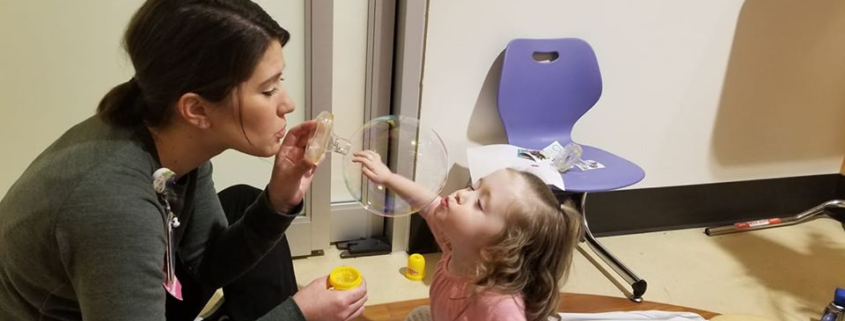
Having medical procedures can be tough for children, especially when many are repeated during a long course of medical care. Though necessary, they do not need to be painful. Maria Sohail, child life intern and Masters Candidate in Child Life and Pediatric Psychosocial Care, explores a range of pain management strategies that can support a child’s mind and body comfort.

A table-top display is set up against tall windows that let in soft daylight. Yellow cards are neatly arranged across the black tri-fold presentation board, each one held in place with a small gold awareness ribbon sticker. Every card shares a printed personal story or message. On the left side of the table, a white sign mounted on black backing is titled: Through Our Eyes and notes the display is sponsored by Kyriaki’s Retinoblastoma Foundation. In front of the board on the table are two pens, a small stack of blank yellow cards for visitors to write on, and a roll of decorative gold ribbon stickers. On the right panel of the display board, one yellow card stands slightly apart from the others, with a handwritten invitation: Please feel free to add your thoughts and comments.

Through Our Eyes at One Retinoblastoma World 2017

Parents and survivors shared their thoughts on the “Through Our Eyes” wall at the One Rb World meeting in Washington D.C., 9-11 October 2017. These powerful insights were gathered anonymously via this website during September 2017, and highlight wide-ranging concerns.

A bold-headed young toddler sits cross legged on a bed, surrounded by medical equipment. She is wearing blue trousers and a gown that is undone at the back and drapes forward. A woman crouching at the table holds both the child’s hands in her own, and they look intently at one another while a medical professional standing to the side prepares to begin a procedure.

One Voice: How Calm Coaching Transforms Children’s Medical Care

Children with retinoblastoma face frequent, stressful procedures that shape trust, pain perception, and medical experience long after treatment. Calm, coordinated support can change everything. WE C Hope CEO, Abby White, and Child Life Specialist, Morgan Livingstone, introduce One Voice – an approach that unifies coaching, empowers parents, and helps teams deliver safer, kinder care – with practical tools families and clinicians can use today.

Two women are seated at a round table in a conference room, directly facing each other as they engage in deep discussion. The woman on the left clasps her hands on her lap and looks highly focused. The woman on the right gesticulates with both hands raised to chest level, palms facing towards the other woman, with her fingers splayed. She appears to be explaining or emphasizing a point, or trying to convey information clearly. A tablet and notepad rest on the table between the two ladies.

Why Being There Matters: Community, Collaboration, and Care at One Retinoblastoma World 2026

One Retinoblastoma World is community, conversation, and collaboration in action. Families, survivors, and professionals unite to share knowledge and lived experience, shaping lifelong Rb care and support. WE C Hope CEO, Abby White, and WE C Hope USA President, Marissa D. Gonzalez, both Rb survivors, explore why being together in San Antonio this September matters so deeply for all in our community.

Five smooth pebbles are stacked in decreasing size on a beach, where lively surf rolls into shore. The high sky is clear blue, with a few clouds above the horizon, which is lightly tinged with a pale peachy glow of sunrise or sunset.

Mindfulness Tips for Retinoblastoma Families and Supporting Teachers

Living with the daily effects of childhood eye cancer can be overwhelming, for all family members. Both the immediate crisis of diagnosis and treatment, and the long-term impacts and risks. Child Life Intern and Student Teacher, Meagan Fuller, highlights some simple mindfulness techniques parents and children can use to ease daily tension.

A young child sits calmly on a white chair, he is holding a light up distraction toy in his right hand, and his left hand is supported by his mother who is behind him. A medical team member with white gloves on is placing a brannula for intravenous access near the wrist of his left hand.

It Doesn’t Have to Hurt: How to Make Needle Procedures Kinder for Kids

Routine blood tests and immunizations often cause pain and fear. Retinoblastoma screening, diagnosis, treatment and follow-up care involves countless needle procedures. It doesn’t have to hurt! Parents and professionals can bring comfort and calm to any needle procedure. Rb survivor and WE C Hope founder, Abby White; and Child Life Specialist, Morgan Livingstone, explore practical, evidence-based ways to reduce needle pain and support healthy coping for babies and children.

A fuzzy, brown teddy bear sits on a table with a blue table cloth. The bear has red and black plaid feet, a cream snout, black eyes, a brown nose, and a black smile. A nasograstric tube and a gastrostomy tube are inserted, and an IV pole and IV fluids are seen to the side. Behind the bear is a teddy bear sized hospital bed and a green curtain.

Play – The Key Ingredient to Pediatric Medical Care

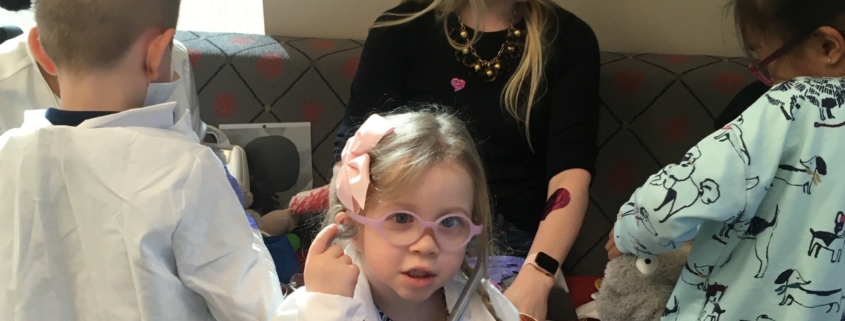
Play is the language, university, and business of childhood. Medical play is a key part of child-focused health care, helping young patients learn, reduce fear, and take part in their care. Sophie Goldberg, child life intern and student of Child Life and Pediatric Psychosocial Care, explores what medical play is, and how you can use it to empower your child through their medical experiences.

A woman faces a crying young girl, gazing at her with a concerned expression as the child site with her head in her hands. She is resting one comforting hand against the girl’s head, and the other on her opposite forearm.

Your Child is Not Misbehaving: How Stress Affects Behaviour

All children exhibit undesirable behaviour at times, particularly when they are stressed, but deliberate misbehaviour is rare. Paediatric nurse and child life specialist, Cindy Pilchuk, explores how a child’s brain responds to stress and emotional overwhelm, what their stress behaviour may be trying to say, and how parents and caregivers can help children cope better.

A baby has a squint - the right eye is rutned in towards the nose.

18 Commonly Confused Retinoblastoma Terms, What They Mean and Why Getting Them Right Matters.

Do you know the difference between lazy eye and squint, or an ocular oncologist and a paediatric oncologist? Do you know when extraocular Rb becomes metastatic, or why trilateral Rb is neither of these? In Part 1 of a mini-series, WE C Hope CEO Abby White explains these and other terms, and why using them correctly is important.

Young patients put a brannula in the arm of a medical play puppet. They are wearing surgical gloves.

Child Life in Kenya: The Sally Test Child Life Program

Children with cancer experience invasive procedures and stressful events throughout their medical care that can impact their ability to cope, inhibit their development and negatively affect their health and well-being throughout life. Child life supports effective healthcare and reduces trauma. Morgan Livingstone CCLS describes how WE C Hope is bringing hope through Child Life to children and their families in Africa.