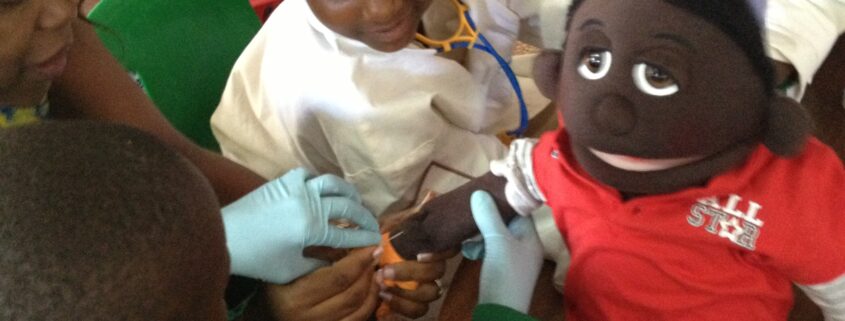
Young patients put a brannula in the arm of a medical play puppet. They are wearing surgical gloves.

Child Life in Kenya: The Sally Test Child Life Program

Children with cancer experience invasive procedures and stressful events throughout their medical care that can impact their ability to cope, inhibit their development and negatively affect their health and well-being throughout life. Child life supports effective healthcare and reduces trauma. Morgan Livingstone CCLS describes how WE C Hope is bringing hope through Child Life to children and their families in Africa.
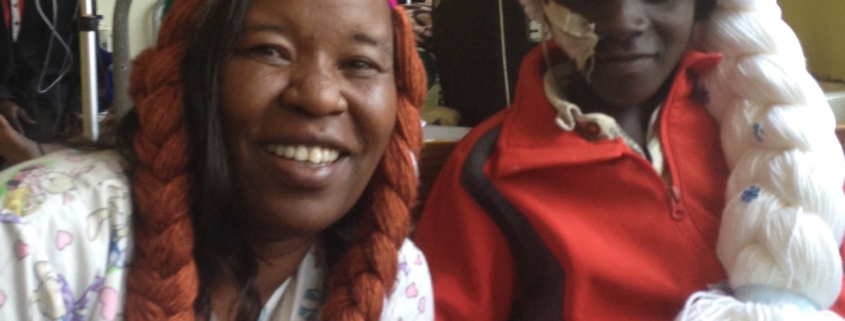
Jayne and a child are pictured wearing long yarn wigs of different colours.

Jayne Kamau, My Friend and Colleague

On March 10, 2019, our beloved child life specialist Jayne Kamau died aboard Ethiopian Airlines flight ET302 as she returned home from SIOPAfrica in Cairo. WE C Hope Child Life Director, Morgan Livingstone, reflects on more than a decade of mentoring, friendship and working together to advance child life in Kenya. Co-authored with WE C Hope CEO, Abby White.

A young child and adult sit side by side at a wooden table, deeply focused on a photo book containing images of hospital environments. The child is holding a red crayon as if poised to take some kind of action as part of their orientation. The adult smiles with warmth and encouragement while pointing at something a photo, helping the child understand what to expect.

Transforming Paediatric Care: Child life in Low- and Middle-income Countries

Most children in low- and middle-income countries face hospitalization without the vital psychosocial support they need. WE C Hope’s Certified Child Life Specialist Morgan Livingstone shares how sustainable child life programs are transforming paediatric care in under-resourced settings. She explores the power of partnership, training, and local leadership in building sustainable child life services that meet unique community needs.

Rati puts on surgical gloves while her mum, Salome, and child life specialist Morgan look on. Both Rati and Morgan are wearing surgical masks. A medical play doll and various medical equipment are laid out beside Rati.

WE C Hope and Child Life: Bridging Gaps, Easing Trauma, Building Hope

Child life helps families cope with retinoblastoma care, reducing trauma, and building hope. Yet access remains limited worldwide. March is Child Life Month and the birthday of our beloved Rati, whose brief life inspired World Eye Cancer Hope. From her care in Canada to Kenya, One Rb World and beyond, WE C Hope CEO, Abby White, explores how child life became central to our mission.

A composite of two photos, each showing a baby boy with identical inward turning left eye.

The Life-Saving Power of a Squint: When to Investigate a Child’s Turned Eye

Evalynn, Gabriel, Abby and John all developed strabismus (squint or turned eye), one of the most common signs of retinoblastoma. This can also occur in healthy eyes or affect multiple family members without eye cancer. Sandra Staffieri, Retinoblastoma Care Co-ordinator at the Royal Children’s Hospital, Melbourne, explains, and answers the key question – when should parents and doctors be concerned?

Close-up of a young African boy smiling broadly. He has short hair and wears a blue tank top. The background is blurred with warm, earthy tones. Overlaying text reads: A photo can identify cancer in a child’s eye. Below a horizontal golden line is the gold KNOW THE GLOW® logo and the text PREVENT CHILDHOOD BLINDNESS. In the bottom right corner are the Kenyan flag and crests of the government and Kenyatta National Hospital, Nairobi.

Pearls of Light: The Pathway to Retinoblastoma Early Detection

Early diagnosis of retinoblastoma saves children’s lives, and offers the best opportunity for safe vision saving therapy. But worldwide, many children are diagnosed late. KnowTheGlow founder, Megan Webber, and WE C Hope USA President, Marissa D. Gonzalez discuss how our early detection partnership evolved, and update on the progress we’re making for children in Africa and Asia.

A young African boy with short, curly black hair and a big, cheerful smile looks directly at the camera. He's wearing a cosy knitted blue sweater over a white collared shirt, and His right arm is flexed in a gesture of strength. The pupil of his right eye has a prominent pearly glow. Overlaying the wooden fence background, bold white text states "NO CHILD SHOULD DIE FROM UNDETECTED EYE CANCER." Below is a horizontal golden line. In the bottom left corner, the gold "KNOW THE GLOW®" logo is followed by the text "PREVENT CHILDHOOD BLINDNESS" in a smaller font. In the bottom right corner are the Kenyan flag and crests of the government and Kenyatta National Hospital, Nairobi.

Between Shadow and Light: Young Lives in Jeopardy from Retinoblastoma

Worldwide, children and their families grapple with life-threatening eye cancer due to delayed diagnosis and care. Unchecked, retinoblastoma has far-reaching consequences. Through two family stories, WE C Hope CEO Abby White explores the impacts of low awareness, slow referral, and delayed care, and the life-saving, sight-saving opportunities they reveal.

Close up of a smiling, playful young African boy with a shaved head, who appears to be leaning against a tree. He has big, bright, happy eyes, one of which has a creamy glow in the pupil. He is wearing a light blue sweater. Across the blurred background, bold white text reads "HELP IDENTIFY CHILDHOOD EYE CANCER EARLY".

A Glint or a Squint Could Be Your Hint: Knowledge is Key to Retinoblastoma Early Diagnosis

Critical clues to a child’s eye cancer hide in plain sight. Parent and physician knowledge, and ability to spot these silent signs are vital to early detection, swift referral, and prompt diagnosis. Meet five children from around the world whose parents’ curiosity, nagging concern, and action were pivotal to their diagnosis and life-saving, sight-saving care.

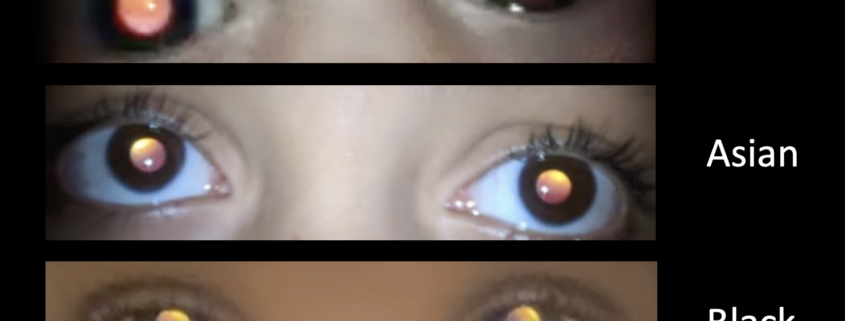
Three sets of eyes represent different ethnic groups, each labelled with their respective ethnicity. The “White” eyes show bright red reflex, the “Asian” eyes display a yellowish reflex, and the 'Black' eyes have a creamy-white reflex. These colours are visible in the pupils of the eyes.

The Arclight and Fundal Reflex Test: Shining the Light on Retinoblastoma

Screening children’s eyes with the Fundal “Red” Reflex is key to early detection of retinoblastoma, but until recently, it was difficult to deliver in many countries. Dr Andrew Blaikie, ophthalmologist and clinical lead for the Arclight Project at the University of St Andrews, describes the importance of this simple exam, and how the Arclight improves eye health access and outcomes for children with eye cancer around the world.

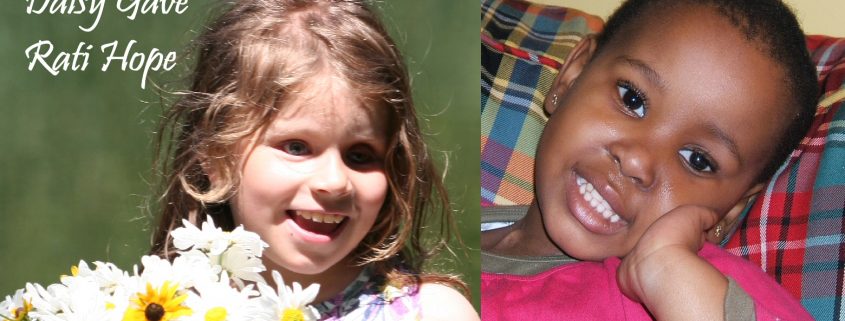
Side-by-side photos of two young girls with a text overlay. On the left, a smiling Caucasian girl with wispy light brown hair, wearing a floral dress, holds a bouquet of daisies. She is outdoors, bathed in sunlight. On the right, a smiling African girl with short black hair relaxes on a colourful plaid sofa. She is wearing a pink top with a ruffled neckline, and rests her cheek on her hand. Across the top, in cursive script, text reads "Daisy Gave Rati Hope".

From One Child to One Rb World: Our Foundation Story

Daisy’s Eye Cancer Fund (now World Eye Cancer Hope) evolved from the generosity of one family sharing hope with another at opposite ends of the earth, creating light within the darkness that retinoblastoma brought to their lives. Rb Survivor and Daisy Fund co-founder, Abby White, shares Rati’s story, and how her experience led to our hope-building work today.