
A child life specialist uses a unicorn horn-shaped bubble generator to distract a young girl and her father. She wears a brightly decorated black surgical cap, adorned with a flowery pink unicorn horn tiara, as well as a face mask, glasses, and surgical gloves. The father also wears a face mask and looks attentively at both the child life specialist and his daughter while securely holding the little girl. Dressed in shades of pink and surrounded by iridescent bubbles, she reaches out toward them with curious delight. In the background, a colourful mural features a smiling face, abstract shapes, and natural elements.

Distraction in Action: How to Build Kids’ Confidence and Comfort in Medical Care

Medical care can be overwhelming for children and their family, causing fear and distress. Without support, these experiences can escalate into medical trauma. WE C Hope CEO, Abby White, and Child Life Specialist, Morgan Livingstone, explore how simple distraction tools reduce anxiety, increase cooperation, and empower both children and caregivers to be calm, confident participants, even in complex medical care.

Rati puts on surgical gloves while her mum, Salome, and child life specialist Morgan look on. Both Rati and Morgan are wearing surgical masks. A medical play doll and various medical equipment are laid out beside Rati.

WE C Hope and Child Life: Bridging Gaps, Easing Trauma, Building Hope

Child life helps families cope with retinoblastoma care, reducing trauma, and building hope. Yet access remains limited worldwide. March is Child Life Month and the birthday of our beloved Rati, whose brief life inspired World Eye Cancer Hope. From her care in Canada to Kenya, One Rb World and beyond, WE C Hope CEO, Abby White, explores how child life became central to our mission.

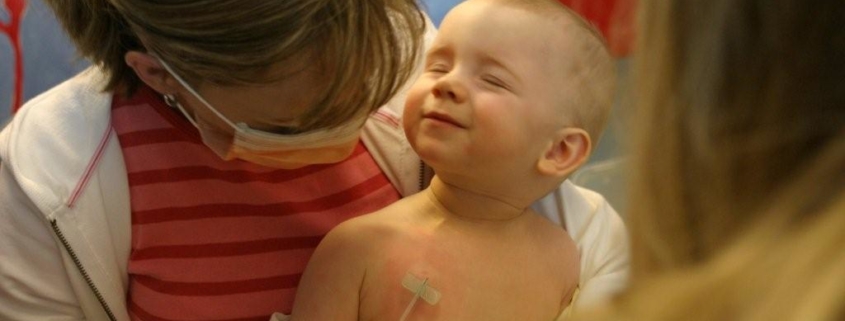
A bald toddler sits on her mother’s lap during a port access procedure. Her back rests against her mother’s chest, and her head is turned up and back towards her mother, who is leaning down in conversation. Both mother and child are white. The nurse accessing the port is seen from behind and has fair hair.

Comfort Positions: How to Help Children Feel Safe and Supported During Medical Procedures

Medical procedures can be stressful for children, often leading to fear, resistance, and lasting anxiety. Comfort Positions offer a simple and powerful way to ease distress, ensuring a safer, more supportive experience for children, caregivers, and medical teams. WE C Hope CEO, Abby White, and Child Life Specialist, Morgan Livingstone, explore how comfort positioning transforms medical care, fostering trust, cooperation, and emotional well-being.